Tom Gruber, 1993

“An ontology is a formal, explicit specification of a shared conceptualization.”

Semantic Cosmos

Click on concept nodes to explore the organic logical structure.

Holistic View Jupiter-class Weak Signal Neptune-class (Ansoff) Semantic Cosmos := Ontology Semantic Materials Mars-class Semantics Earth-class Top-Down Static Mercury-class System Dynamics Saturn-class (Closed-Loop) Ontological Regression Red Dwarf (Bottom-Up)

Ontology := Semantic Cosmos

Worflogy's dynamic reinterpretation of Tom Gruber's (1993) definition: "a formal, explicit specification of a shared conceptualization." Rather than a static declaration, it is a living knowledge structure where a Holistic View and Weak Signals constantly interact. Click on the nodes to explore.
가나다
ABC
+ − =
123
√ ÷ %
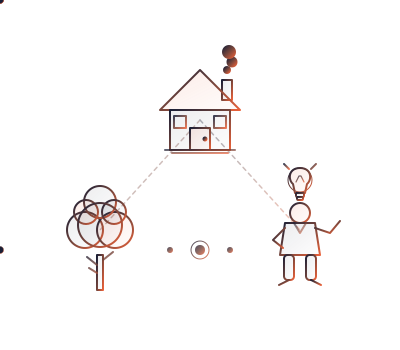
House, Tree, Person
Ontology Workflow
The Future Snowball of the Small Ball Worflogy Has Launched

A New Paradigm of the Evolution and Supply of Self-Sustaining Knowledge Context

1. Ontology-based System Dynamics

A closed-loop control system of cognitive architecture that simulates static knowledge data (Stock) and inference rules (Flow) in a real-time feedback loop via a time controller (Δt).

graph TD subgraph External_Signal [External Environment / Faint Signal] WeakSignal[Weak Signal
An early sign of change yet to take form
ex. A glimmer of light at the edge of the chessboard in darkness] end subgraph Integrated_SD_System [Ontology-based System Dynamics - Closed Loop] direction TB Ontology[Static Ontology DB
Current State: Stock
ex. Moons Power 100 / My Anger 50] RuleEngine{SWRL / Rule Engine
Change Rule: Flow
IF Anger 40 THEN Trigger Resistance} TimeController((Time & State Controller
Time Progress: Δt
Mathematical Operation & Update)) Ontology -- ① Provide Current State t Data --> RuleEngine RuleEngine -- ② Infer Event/Change on Condition Met --> TimeController TimeController -- ③ Progress Time t+1 & Overwrite New State --> Ontology end subgraph LLM_Interface [AI / User Layer] LLM[Language Model / AI Agent
Flexible Context Understanding & Interface] end %% Weak Signal → Ontology (External signal input) WeakSignal -.->|⑥ Unclassified Pattern Signal Input
Ontology Update Trigger| Ontology %% Guardrail Connection LLM -.->|④ Hallucination Prevention Verification Grounding
Establish Secure Context Network| Ontology TimeController -.->|⑤ Block Action on Rule Violation Risk Mitigation| LLM style Ontology fill:none style RuleEngine fill:none style TimeController fill:none style WeakSignal fill:none
Click to open the board
Traditional Top-Down Ontology Design & Its Present Value Combined with LLMs

From Limited Semantic Search and Rule-Based Reasoning to Rapid Machine Situational Awareness and Data Orchestration

2. Semantic Inference Rules

A semantic inference rule network of the rule engine that derives complex sociological conformity, resistance behaviors, and the resulting causal isolation status from current state data.

graph LR subgraph Rule_1 [Rule 1 : Inferred System Conformity & Worship] R1_Cond[IF
Moon x AND hasLocation x, Chessboard
AND Crowd y AND hasLocation y, Chessboard] R1_Engine{SWRL Inference Engine} R1_Result[THEN Inferred
worships y, x
Crowd worships Moon] R1_Cond --> R1_Engine --> R1_Result end subgraph Rule_2 [Rule 2 : Inferred Emergence of Resistance] R2_Cond[IF
I x AND hasEmotion x, Anger
AND Stone z AND hasLocation z, Cliff
AND Moon y] R2_Engine{SWRL Inference Engine} R2_Result[THEN Inferred
throwsAt x, z, y
I throw a stone at Moon] R2_Cond --> R2_Engine --> R2_Result end subgraph Rule_3 [Rule 3 : Inferred Isolation & Intersection of Gazes] R3_Cond[IF
throwsAt I, Stone, Moon
AND misses Stone, Moon
AND worships Crowd, Moon] R3_Engine{SWRL Inference Engine} R3_Result[THEN Inferred
staresAt Crowd, I
hasStatus I, Isolated
Crowd stares at I / Isolated status assigned] R3_Cond --> R3_Engine --> R3_Result end

3. Domain Ontology Schema

A static semantic network consisting of a T-Box class hierarchy and an A-Box instance structure, organically structuring objects' locations, entities, and relationship attributes (rdf:type).

graph TD %% [T-Box] Class Hierarchy subgraph T_Box [Conceptual Framework: T-Box Classes] Actor[Actor] Location[Location] Object[Object] Phenomenon[Phenomenon] Emotion[Emotion] end %% [A-Box] Instances subgraph A_Box [Instance System: A-Box Instances] Me((I)) Crowd((Crowd)) Cliff[(Cliff)] Chessboard[(Chessboard)] Moon{Moon} Darkness[Darkness] Stone>Stone] Anger[Anger_Sorrow] end %% Instantiation (is-a relations) Me -. "rdf:type" .-> Actor Crowd -. "rdf:type" .-> Actor Cliff -. "rdf:type" .-> Location Chessboard -. "rdf:type" .-> Location Moon -. "rdf:type" .-> Phenomenon Darkness -. "rdf:type" .-> Phenomenon Stone -. "rdf:type" .-> Object Anger -. "rdf:type" .-> Emotion %% Object Properties / Predicates Me -- "hasLocation" --> Cliff Crowd -- "hasLocation" --> Chessboard Stone -- "hasLocation" --> Cliff Me -- "hasEmotion" --> Anger Anger -- "hasTarget" --> Moon Cliff -- "isAbove" --> Chessboard

Inquiries

Please feel free to contact us if you have any questions regarding collaborations, networking, or educational content for Contexton.

Education Service Inquiry